

The CD player has gone the way of the Walkman and the record player before it. For several years, consumers have increasingly turned to their smartphones to listen to digital music, and the change has destroyed once-giant retailers like Virgin and Tower Records.
On a street in Brooklyn’s Flatbush neighborhood, Ellen Chen found one of New York City’s rare surviving CD retail stores.
Host intro by Adrian Ma
It’s chilly and windy on Nostrand Avenue in Flatbush. People tuck their hands in sleeves as they walk through this neighborhood, home to many of the city’s ethnic Haitians. Then, just across Cortelyou Road, they hear something that sounds like a soft Caribbean breeze.
[Sounds of music playing]
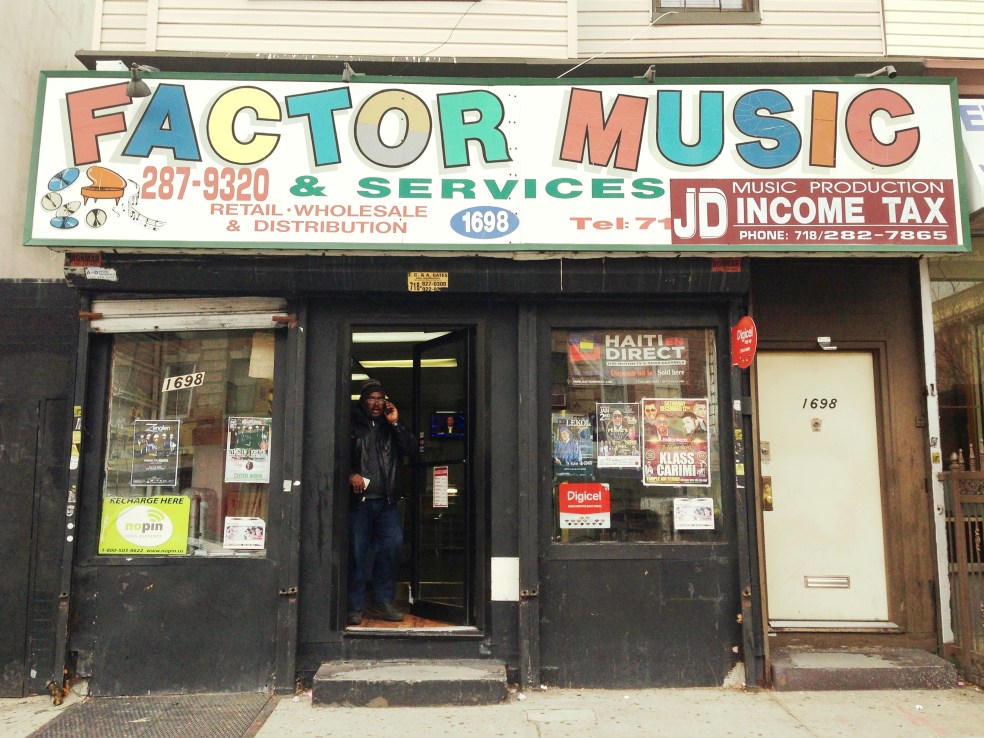
The warm sounds pour out of a store decorated with posters of the latest CDs from Haiti. A white sign of the store’s name “Factor Music” hung above the door. It’s a Haitian music record store that has been in business for 18 years.
The music, known as Kompa, brings to mind the salty freshness and passionate sunshine of the Caribbean. Kompa makes people want to sway and dance, and it is the Haitian music genre that the store owner, Fritz Duverger, plays most often.
One wall of Duverger’s store is devoted to CD racks. Besides Kompa, he offers Twoubadou, Méringue, mini-Jazz, Rara, and many other Haitian music genres. On an ivory cupboard on the right, a dozen vinyl records dating back to the 1970s lie within cardboard covers that have turned slightly gray.
If you are lost among these numerous choices, Duverger will offer guidance – this genre is fast, but for slower music, check out something else. But the final decision is always left to the customer.
Duverger came from Haiti to the U.S. in 1968. In the 1990s, he and his brother promoted tours by several small Haitian bands in America. He then developed his interest in music and opened the store, welcoming Haitian music lovers.
[Sounds of faster music playing]
Music like this Kompa album has made the store a magnet for years – a rare place offering a wide range of music from Haiti. In its heyday, the store sold nearly $5,000 worth of CDs every week.
By the early 2000s, though, sales began to slow, hurt by the rise of digital libraries and portable music players. According to the Recording Industry Association of America, nationwide CD unit sales have dropped by more than 80% since 2000.
Other Haitian music record stores in the city gradually went out of business during the past decade. Now there is only Duverger and one other Haitian music store in Queens.
In order to keep his store open, Duverger has diversified his business. Many of the customers who drop in today are here to buy international pre-paid phone call credits, or special cable boxes that can access Haitian TV channels – bigger moneymakers than his CD collection. Now 95% of his revenue comes from these side-businesses. Today, says Duverger, the store’s weekly revenue hardly maintains $1,000.
You wouldn’t necessarily know that by looking at the interior of the store, which is still dominated by CDs. But Duverger says now he only has one or two music customers at most per day.
And really, why buy bulky CDs when tiny digital chips can store at least 500 songs on a phone? Even if you want to buy Haitian music CDs, you would have trouble finding Duverger: the only trace of his store online is a Facebook page created a few years ago, with 3 posts and 17 likes.
“I try to survive.” This is a sentence Duverger repeats often while talking about his business. His efforts have kept the sounds of Haiti flowing through Flatbush for almost two decades. How much longer can he survive? Duverger says he has no clue.
For Global City NYC, I’m Ellen Chen.
 Ellen Chen